
Anderson County Release Date Meaning
There is no single date that works for every Anderson County inmate. A pretrial detainee at the Anderson County Detention Facility is held while a case is pending. Release can turn on a bond payment, an own-recognizance order, placement with the local PreTrial Release program, dismissal, or another court order. Those events do not create a sentence-based projected release date. The order may also come before the person finishes physical release processing. A warrant, detainer, or second case can keep custody in place.
A sentenced person has a calculation, but the public labels matter. Tennessee’s Felony Offender Information Lookup, known as FOIL, does not publish a field called “Projected Release Date” or “Tentative Release Date.” Its exact fields are Release Eligibility Date and Sentence End Date. Release Eligibility Date marks a point when an applicable release process may begin. It is not a promise of exit. Sentence End Date reflects the sentence calculation on file, yet it can differ from the day the person leaves prison because parole, mandatory supervision, credits, later court documents, and other custody can affect the path.
For someone already released, read actual release information and Supervision Status instead of treating an old eligibility date as proof. “Parole” and “Probation” both indicate community supervision may continue. “Inactive,” especially with no active Tennessee sentence, can support the end of TDOC involvement. Exact historical confirmation still comes from the retained discharge file.
Anderson County FOIL Date Search
The Tennessee FOIL search covers felony offenders currently or formerly in TDOC custody or supervision. It does not cover every Anderson County jail booking. Someone who posted bond on a local misdemeanor may never enter FOIL. By contrast, a person whose Anderson County booking ended through transfer to TDOC may appear as incarcerated at an Assigned Location. That is a custodial transfer, not release into the community.
Use identifiers carefully. The direct search accepts a name with optional race and alias choices, a TDOC or TOMIS number, or a State ID known as a SID. A name can return more than one person. Match date of birth, TDOC ID, SID, aliases, physical description, sentence, and offense before reading any Anderson County release date as belonging to the right person.
- Identify the last known custodian. Use FOIL for a Tennessee felony sentence, not as a general Anderson County jail roster.
- Search by TDOC ID or SID when available. Otherwise use the person’s full name and include aliases when that choice is useful.
- Open the matching detail and record the exact labels: Supervision Status, Assigned Location, Sentence Begin Date, Release Eligibility Date, and Sentence End Date.
- Read active sentences, combined sentence length, and parole fields with those dates. One date by itself does not explain custody.
- For a past release, request the discharge record if the actual date or terms must be documented.
The official TDOC FOIL description explains that the system includes current and former felony offenders and can supply status, sentence, parole, location, and release information. The captured official screen below shows the state’s own description of that coverage.
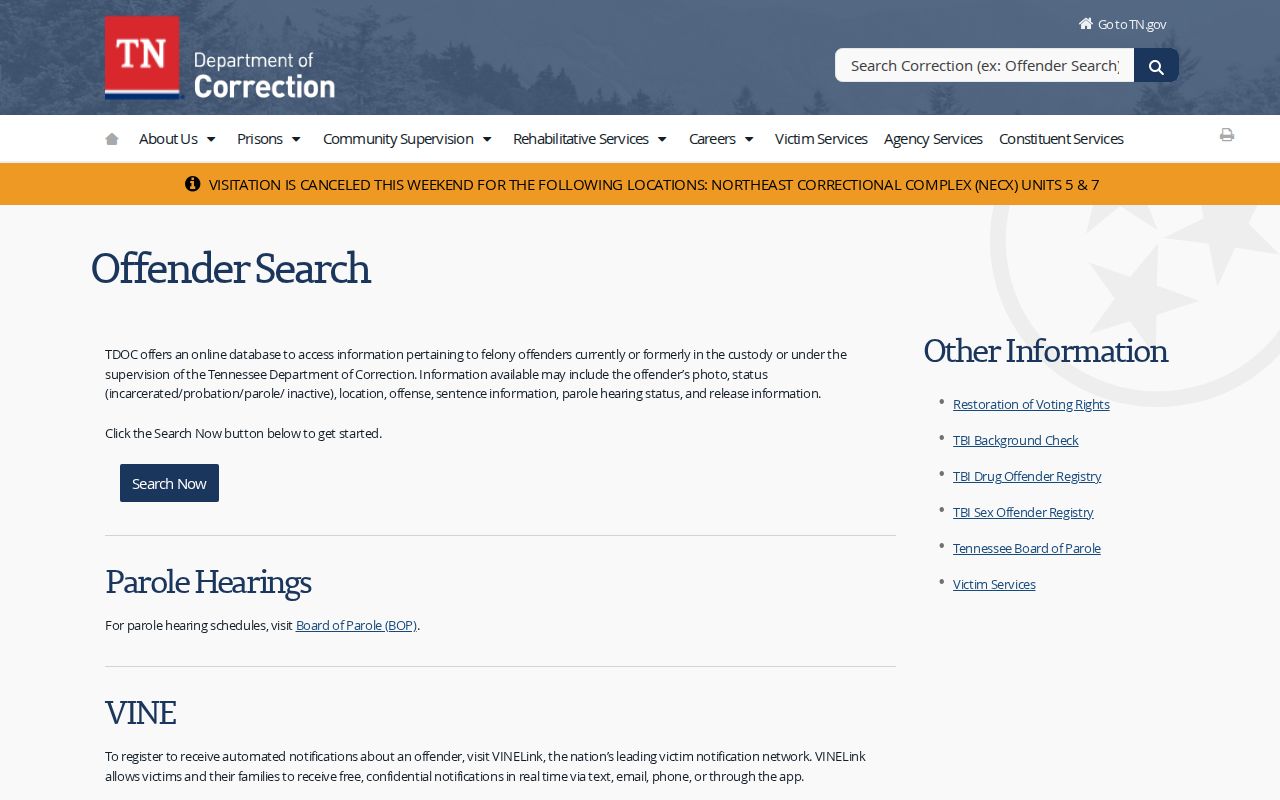
This screen helps define FOIL’s role: it is the state felony source, while a county-only booking must be checked through Anderson County jail and court records.
Note: Save the date and time viewed because FOIL warns that sentence dates may change when added court documents reach TDOC.
Anderson County Jail Date Route
A local Anderson County sentence needs a different route. Start with the Anderson County Detention Facility, operated by Sheriff Russell Barker’s office, at 865-457-7100, then identify the court case and judgment. Ask for the sentence, credited jail days, the court-set release percentage when relevant, any good-conduct deduction, and the calculated release date. The court judgment supplies legal terms. The jail or TDOC calculation applies credit and conduct information. Hand arithmetic cannot replace either record.
The county portal can show a populated Release Date after a booking closes. That is evidence about an actual closed booking, not a forward-looking estimate. A blank Release Date does not establish a future release day. Likewise, disappearing from the current roster is inconclusive because the person may have bonded out, transferred, moved under a court order, or left the display for another reason. Use the Anderson County docket gateway to identify the court route. The broader custody and records process is available through the Anderson County released-inmate search.
- Release Eligibility Date
- The FOIL date at which the person reaches eligibility for the applicable state release process.
- Sentence End Date
- The end date from the sentence calculation then held by TDOC, subject to later documents and lawful changes.
- Actual Release Date
- The date physical custody ended for the identified booking or agency, which may lead to supervision or another custodian.
- Detainer
- A request or hold tied to another authority that can prevent community release or cause an immediate transfer.
Anderson County Sentence Credits
Tennessee sentence credits are controlled by the sentence, offense date, classification, conduct, and governing law. Under Tenn. Code Ann. § 41-21-236, an eligible state offender may earn one to sixteen days per month, with no more than eight for good institutional behavior and eight for satisfactory program performance. Credits must be earned and retained. They can be reviewed or removed, so they are not a fixed discount promised at sentencing.
The effect also changes by offense and date. For covered offenses before July 1, 2024, and for later sentences under two years, credits may affect the sentence as allowed by law. For felony terms of two years or more arising from offenses on or after July 1, 2024, credits may reduce a percentage used for parole eligibility but do not change sentence expiration. Section 41-21-236(i) further limits reduction before the earliest Release Eligibility Date for covered offenses. TDOC, not a public calculator, is assigned responsibility under § 41-21-1006 for covered felony sentence-expiration and earliest-release calculations, including qualifying felony sentences served locally.
County workhouse sentences have a separate rule. Tenn. Code Ann. § 41-2-111(b) provides a one-quarter deduction for upright behavior on a qualifying county jail or workhouse sentence under one year, including covered pretrial and post-trial confinement. The sheriff or superintendent may revoke all or part after a due-process disciplinary hearing. That does not justify a blanket promise of “25 percent off.” The judgment, conduct record, other holds, and current official calculation must all support the Anderson County release date.
No Universal Tennessee 85% Rule
Tennessee does not have one rule saying all prisoners serve 85 percent. Tenn. Code Ann. § 40-35-501 contains several offense-specific and date-specific systems. Some older categories use 85 percent less permitted credits, subject to statutory floors. For certain listed offenses committed on or after July 1, 2022, subsection (bb) can require service of 100 percent of the imposed term without a credit reduction to that term. Later amendments also affect whether credits change parole eligibility or sentence expiration.
Correct interpretation requires the precise offense, offense date, sentencing range, concurrent or consecutive structure, pretrial credit, retained credits, applicable eligibility subsection, later court filings, and any detainer. “Concurrent” means terms run together. “Consecutive” means one term follows another. A date guessed from the total years or from a broad percentage can therefore be wrong even when the arithmetic is sound.
A Tennessee Board of Parole hearing adds another stage. Eligibility permits consideration, not release. A hearing can be deferred or denied. Even after a grant, TDOC explains that a release plan must be investigated and approved before physical release. The Anderson County projected release date should always be reported with its exact field name and current status.
Note: Offense date and current law control, so use the judgment and TDOC calculation rather than a general sentence-percentage claim.
Why Anderson Release Dates Change
Expected dates move for both legal and administrative reasons. The key question is what changed in the official record. A corrected judgment can alter credit or sentence structure. Discipline can affect retained credits. A favorable parole step can still stop before release-plan approval. Another agency’s hold can turn a planned community release into a transfer.
| Change | Possible effect | Best confirmation |
|---|---|---|
| Corrected judgment or jail-credit report | Moves eligibility or sentence-end calculations | Court file and TDOC calculation |
| Concurrent or consecutive alignment | Changes how multiple terms combine | Judgment and active-sentence details |
| Credits earned, restored, withheld, or removed | Changes an eligible calculated date | Current sentence calculation |
| Parole denial, deferral, rescission, or plan issue | Prevents exit on an expected eligibility path | Board result, FOIL, and TDOC |
| New warrant, charge, or detainer | Continues custody or sends the person to another agency | Responsible court and custodian |
| Later court documents | Causes FOIL dates to be revised | FOIL plus the underlying order |
None of these factors should be inferred from a missing roster entry. Contact the record owner and quote the person’s identifier, field label, and the date the screen was viewed. That gives the office a clear discrepancy to review.
Confirm Anderson County Actual Release
A final check should match the source to the custody type. For a county booking, obtain the closed booking record and actual Release Date from Anderson County. Pair that record with the court order when the legal basis matters. For a Tennessee felony sentence, use FOIL for discovery and current status, then use the TDOC archived-record request for the actual discharge date, cause, terms, release authorization, sentence calculation, or transfer history.
Records Management asks for a full name, TOMIS number, date of birth, requester contact information, and a detailed description. It may also accept other identifiers when known. The office is in the Rachel Jackson Building, 2nd Floor, 320 Sixth Avenue North, Nashville, Tennessee 37243-0465, and its listed phone is 615-253-8079. Archive charges may apply, so wait for TDOC to state an amount rather than sending advance payment.
VINE can add a timely custody-change notice, but it is not a certified discharge record or complete archive. A VINE event also does not rule out a transfer or supervision. Instructions for matching a person and registering a notice are on the VINELink Check page. Actual release is strongest when the agency’s closing record and a compatible court or state record agree.