
No Anderson 72-Hour Release Feed
Anderson County does not publish a sheriff-promoted page called a 72-hour release list. The same iSOMS system used for local jail information accepts an hours=72 portal view and labels it “Current Inmates / Last 72 Hours.” Sheriff Russell Barker's office did not link that parameterized screen on the research date. It is an observed function of the official portal, not an advertised release service.
The results group bookings by recent intake. Some individual records remain in the window after their Release Date is populated. Those entries can confirm that the shown booking ended. Yet the window omits people who were booked earlier and happened to leave during the three-day period. It also lacks a published release-only filter, refresh schedule, and archive promise.
The sheriff's official menu shows its promoted “24 Hours Arrest List” and Current Inmates choices, but no linked 72-hour release feed.
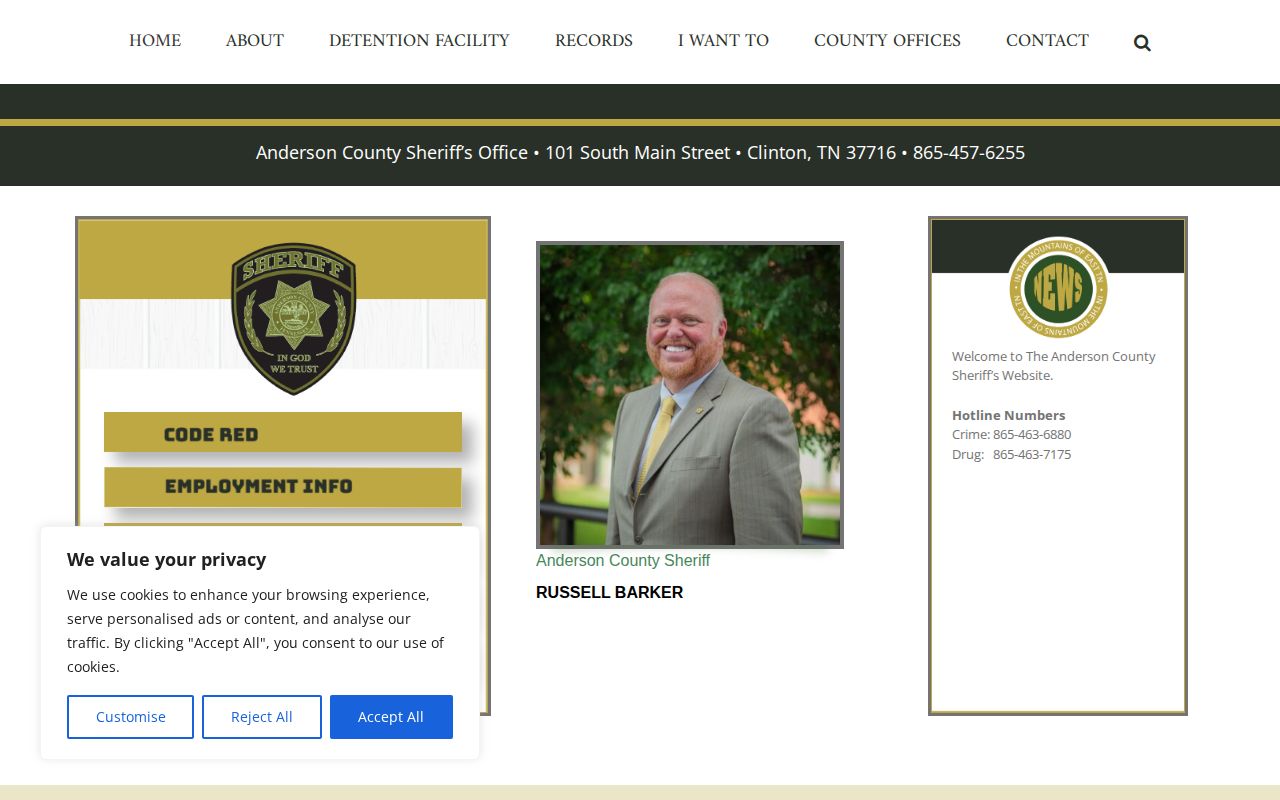
The menu capture helps separate an official sheriff link from the wider portal parameter that must be used with care.
Check Anderson County Three-Day Releases
The 72-hour view is most useful when a person entered the Anderson County Detention Facility within the last three days. It expands the intake cohort, not the release period. Search the visible records and use the available last-name controls and pagination. Then compare enough details to avoid mixing two people who share a name. Age, city, intake time, arresting department, charge, and bond can all help.
- Open the portal's Last 72 Hours URL and locate the recent Anderson booking.
- Match the person through the intake date, age, city, arresting agency, charge, or another shown field.
- Inspect the individual Release Date. A blank field is not proof of release.
- Write down the view date and exact field text because the public results are live and may change.
- Confirm release type, time, and destination with the jail, court file, notification system, or requested booking record.
For an intake that happened today, the Anderson County 24-Hour Release List narrows the same type of check. Neither window replaces documentary confirmation.
Note: A longer result window raises the number of records to match, so use identity details and never rely on name alone.
Anderson 72-Hour Release Fields
The three-day portal displays the same field family as the shorter view. Several fields describe the arrest and intake rather than the exit. One field, Release Date, can show that the displayed booking closed. The portal does not state release authority, exact destination, or whether another agency took custody.
| Displayed field | How to read it |
|---|---|
| Photo or no-photo image | A booking image or placeholder tied to the entry, not a release finding. |
| Name, age, class, race/sex, city | Person descriptors useful for matching a common name. |
| Intake date and time | The event that places the booking in this 72-hour cohort. |
| Arresting department and officer | The local agency information shown for the arrest. |
| Release Date | When filled, status evidence that the displayed Anderson booking ended. |
| Charge and bond | Case context that does not, by itself, prove release or its reason. |
The Anderson County Last 72 Hours screen shows the live layout and release field in its real context.
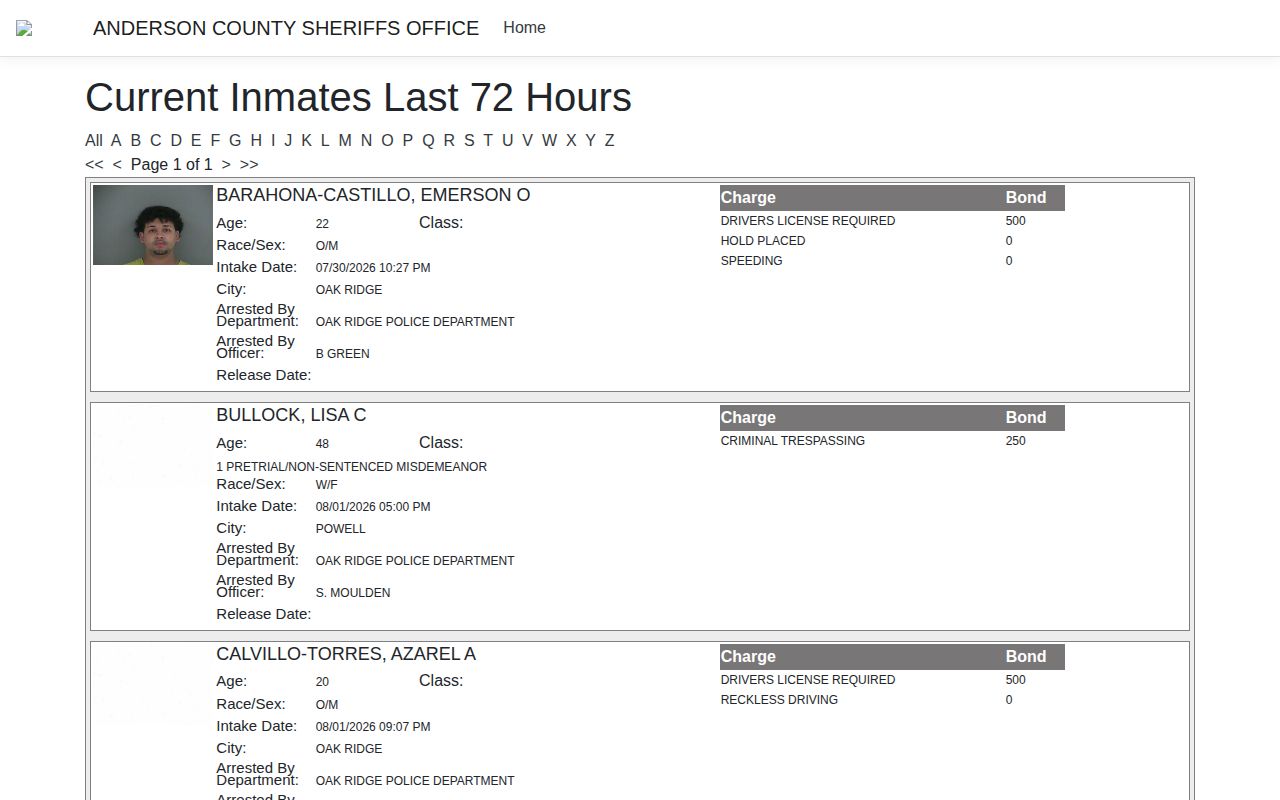
The screenshot reinforces that the records are recent intake entries, even when an individual entry later displays a Release Date.
Anderson Weekend Release Checks
A three-day span is useful after a weekend because it preserves more recent intakes than the one-day view. For example, a person booked before the current calendar day may still fall within the broader cohort. This is a discovery benefit. Research did not locate an Anderson County policy stating that weekend or holiday releases update on a set schedule, nor did it identify a promised processing time.
Do not assume the window “catches” all weekend releases. A long-held detainee released on Sunday may have an intake date far outside the view. A court order can also precede the jail's physical exit and portal update. If a family pickup, legal deadline, or other time-sensitive issue depends on the event, call the jail at 865-457-7100. Ask whether the person remains in Anderson custody and whether another hold or receiving agency affects the exit.
Holidays create the same caution. The portal's retention and correction cadence are unpublished, and court or records offices may follow different schedules. Record what the portal says without predicting when a blank Release Date will change.
Why Anderson Releases May Be Missing
The local roster quirk is easy to misread. The sheriff promotes a 24-hour arrest list, while iSOMS accepts a 72-hour parameter that the menu does not show. Both are intake cohorts. A newly booked person can stay visible after release, but a person booked weeks earlier and released in the last three days can be wholly absent. Thus, presence may help discovery, while absence answers almost nothing.
No source states how often the portal refreshes, how long a closed entry stays online, or how corrections are handled. A release record can also disappear from public view before the underlying sheriff record reaches the end of its lawful retention. The stable response is a narrow records request for the closed booking and release event, not repeated refreshing or an assumption based on a vanishing name.
This distinction is especially important when a booking closes through transfer. The Anderson Release Date can mark the end of county custody even though TDOC, another county, a federal authority, or immigration custody begins at once. The receiving agency or court record must establish what followed.
Note: Save the exact portal label and access time because “Release Date” is not interchangeable with a court order time or state release-eligibility date.
Anderson Release Records Fallback
Start the fallback with the Anderson County Detention Facility at 308 Public Safety Lane in Clinton. Its information line is 865-457-7100. The sheriff's fee page lists a $5 booking record. A focused request should identify the person and date range, then ask for booking and actual release timestamps, release type or authority, destination or receiving agency, booking number, charges, bond information, and the linked booking photo when relevant.
Use the Anderson court docket gateway when the legal basis matters. A case record can contain a bond order, dismissal, judgment, probation order, commitment, or release direction. The court event may explain why custody should end, though it is not always the physical gate time. For a named-person search across those branches, use the Anderson County released inmate lookup and keep the county, state, and federal paths separate.
| Channel | Best use | Main limit |
|---|---|---|
| Anderson jail or booking record | Confirm local booking closure, release details, or transfer. | Protected data may be redacted. |
| Court docket and file | Find the order or case event tied to release. | Order time may differ from physical exit. |
| Tennessee SAVIN/VINELink | Receive or check a participating custody-change event. | Not a certified historical record. |
| TDOC FOIL | Check a person who entered Tennessee felony custody or supervision. | Does not cover every local jail booking. |
| Federal or ICE locator | Follow facts that point to federal or immigration custody. | Each system has its own limited scope. |
Two compatible official facts are stronger than one screen. A portal Release Date and court order can work together. So can a VINE custody event and jail confirmation. Two sites that copied the same roster are not independent sources.
Anderson Release and Transfer Evidence
A current-inmates match supports current Anderson County Detention Facility custody as displayed. A missing name does not identify the next event. The person could have bonded out, finished a local sentence, moved under a court order, transferred to TDOC, entered another agency's custody, or been affected by a name or data issue.
A populated Release Date is better evidence that the shown booking closed, but it still does not prove community freedom. If Tennessee felony custody followed, TDOC's FOIL may show an Assigned Location or a community Supervision Status such as parole or probation. If the case was federal, the BOP locator applies to sentenced federal prisoners. ICE's public locator is mainly for current custody and is not a dependable historic release register.
The same labels should not be blended. An Anderson iSOMS Release Date, a TDOC Release Eligibility Date, a BOP Released date, and a VINE custody event describe different agencies and events. Quote the actual term and its source.
Preserve Anderson Three-Day Results
The 72-hour view is temporary by design, even though no exact retention period is published. When a matching entry matters, note the full name, intake date and time, Release Date, charge, bond, arresting agency, and the moment the screen was checked. Those facts help the custodian locate the closed booking after it drops from the public window.
A narrow request reduces ambiguity. State that the request concerns the Anderson County Detention Facility booking, give the known dates, and distinguish inspection from a copy. Ask separately for the release event and any booking photograph so the records office can identify each item. Tennessee residency proof is part of Anderson County's published public-records policy, and the custodian may quote lawful copy or labor charges beyond the sheriff's listed booking-record price.
Most important, ask the question the portal cannot answer: did the person enter the community or another custodian's control? A receiving-agency field, release authorization, bond receipt, or signed court order can supply that missing context. The wider window begins the search. The record closes it.
Note: Preserve the portal time and booking identifiers before the Anderson County three-day entry drops from public view.