
Anderson County Parole vs Probation
Parole is conditional release from incarceration before a state sentence expires. The Tennessee Board of Parole makes the release decision, but a grant alone does not open the prison gate. A probation or parole officer must investigate the proposed release plan, and the plan must be approved before physical release. Probation is a court order that places a person in the community under set terms. It can begin without a prison term or follow a jail part of a split sentence. Anderson County records may also use determinate release, mandatory reentry supervision, or community corrections. Those are distinct legal forms, so the label in the judgment and the Tennessee Department of Correction record controls.
The TDOC types of release describe the state categories. The comparison below keeps the main Anderson County parole and probation paths separate.
| Supervision type | Who authorizes it | Best verification source |
|---|---|---|
| Parole | Tennessee Board of Parole, followed by release-plan approval | FOIL status, Board information, and TDOC District 21 |
| Felony probation | Sentencing court | Court judgment, FOIL, and TDOC District 21 |
| Misdemeanor probation | Anderson County court | Court file and the local misdemeanor probation contact |
| Pretrial release | Court before adjudication | Bond or release order and the Anderson County PreTrial Release office |
A person on any of these paths may be living in the community. That does not mean the sentence or case has ended. Sheriff Russell Barker's jail record can establish whether Anderson County custody closed before a supervision status is interpreted. The full Anderson County released inmate search and record path separates that event from state supervision.
Verify Anderson County Post-Release Supervision
Start with the Tennessee Felony Offender Information Lookup, known as FOIL, when the person had a felony sentence or TDOC involvement. FOIL covers people currently or formerly in TDOC custody or supervision. A result may show Parole, Probation, Inactive, or an incarceration status. Read Supervision Status with Assigned Location, active sentences, Sentence End Date, Release Eligibility Date, and parole fields. A name-only match is weak. Compare the date of birth, TOMIS or TDOC number, SID, aliases, physical descriptors, and sentence information before attributing a status.
Use this order to verify Anderson County parole or probation:
- Open the TDOC FOIL search. Search by full name with aliases, TOMIS ID, or SID, then complete the CAPTCHA.
- Match the person with more than a name. Record the exact Supervision Status and Assigned Location labels, plus the date and time viewed.
- Locate the Anderson County court case. The county docket gateway separates Circuit/Criminal Court from the two General Sessions divisions.
- Read the signed judgment, probation order, release order, or revocation document. A docket line may not contain the full terms.
- Call the office responsible for that supervision type when the records conflict or the status needs agency confirmation.
Inactive generally points to no active TDOC custody or supervision, but it does not explain every part of the prior discharge. For exact history, request the state discharge record. Tennessee law calls for a TDOC record of the date, cause, and terms of discharge, the condition at leaving, and transfers. That retained record is stronger proof than a current search screen.
Note: Save the exact status label and view date because FOIL information can change when TDOC receives later court documents.
Anderson County Supervision Office
TDOC District 21 serves Anderson, Fentress, Morgan, and Scott counties. Its current directory places the district office in Clinton. Two official sources publish different phone numbers for the Clinton felony probation and parole location, so the directory number should be tried first and the alternate should be telephone-verified before it is relied on. The office can clarify which agency holds a current supervision case or the meaning of an apparent status conflict. It should not be asked to disclose a protected home address or reporting schedule.
Tennessee DOC District 21
110 E. Centre Stage Business Park
Clinton, TN 37716
Primary: 865-220-4001
Alternate published number: 865-220-6529
Fax: 865-463-7084
Best use: Anderson County felony parole and felony probation status or agency routing.
Office contact is the final check after the records have been matched. Bring the full name, date of birth, TDOC or SID number if known, and the exact FOIL label. The office may confirm the responsible agency without releasing private supervision details.
Anderson County Probation Paths
Local misdemeanor probation is separate from TDOC felony probation. The Anderson County Circuit Court Clerk publishes 865-463-7885 for misdemeanor probation. The Anderson County PreTrial Release office serves indigent defendants before adjudication at 100 North Main Street, Room 103, Clinton, with phone 865-457-6279. Pretrial release means jail custody has ended while the criminal case remains pending. It is not probation after conviction and is never parole.
The court file is essential when the category is unclear. Anderson County's system can involve General Sessions Division I in Clinton, General Sessions Division II in Oak Ridge, and Circuit/Criminal Court. A felony can begin in General Sessions and move to a new Circuit/Criminal case number. The Circuit Court Clerk can route a request for the judgment, probation order, bond order, violation filing, or signed release authority. Court papers show the legal basis. The supervision office confirms the current administrative path.
- Parole
- Conditional community release before a state sentence expires.
- Probation
- Court-ordered community supervision under stated terms.
- Pretrial release
- Community release before the charge has been adjudicated.
- Discharge
- The formal end of custody or supervision under the controlling record.
Note: A bond release, probation order, parole grant, and discharge mark different events and should not be treated as interchangeable.
Anderson County Parole Hearing Records
The Tennessee Board of Parole is an independent seven-member agency. Hearing officers conduct fact-finding hearings and make nonbinding recommendations. Board members may adopt, change, or reject those recommendations. A scheduled hearing is not a release decision, and a favorable recommendation is not an actual release. The sequence may include eligibility, a hearing date, a recommendation, a final grant, release-plan approval, and physical release. Each event must be confirmed on its own terms.
The Board separates schedules for state prisons and county jails. It says schedules update each Monday, or Tuesday after a Monday holiday, and remain subject to change. The schedules include the TOMIS number, person, hearing type, hearing date, and facility. They are not a public statewide results database. FOIL may show Parole Hearing Date and Parole Hearing Result. Final clarification can come from the Board at 615-741-1150 or BOP.Webmail@tn.gov.
The Board parole-hearings page shows the current schedule process and hearing types.
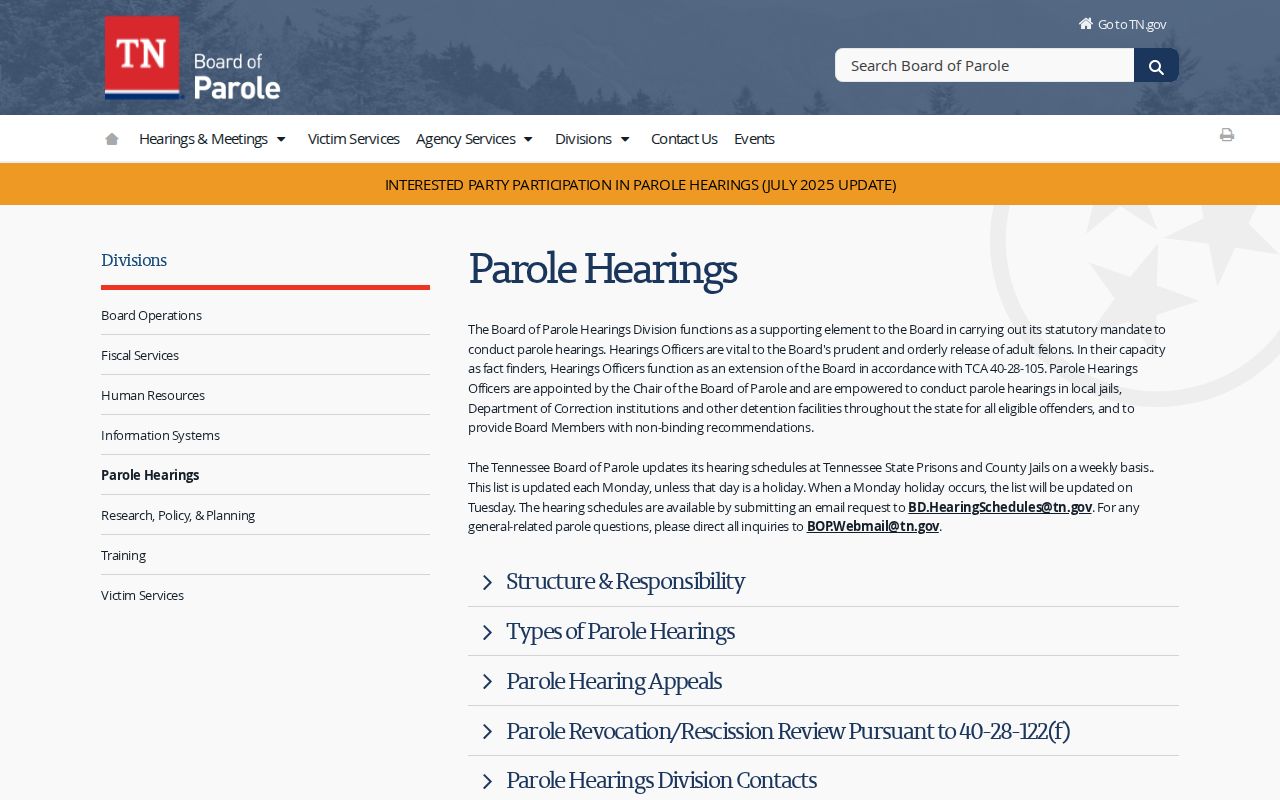
The official screen supports the weekly schedule route, but a listed hearing must still be followed by a decision source and, when granted, TDOC release-plan approval.
Appeals under Tenn. Code Ann. § 40-28-105 are limited. The research identifies significant new information, substantiated official misconduct, or a significant procedural error as the listed grounds, with a request due within 45 days after the person receives the final decision. A granted appeal goes to the next available docket. This process reviews the parole decision; it does not itself prove release.
Anderson County Absconder Status Checks
No official public Anderson County or TDOC absconder list was found. An absconder is a supervised person whom the responsible agency has formally identified as failing to remain in contact or comply with supervision in a way that triggers that status. A blank location, a missed search result, or a rumor does not establish it. Nor does a preliminary parole-revocation hearing. That hearing asks whether probable cause exists. A final revocation hearing decides whether a violation occurred and whether parole will be revoked or reinstated.
The accurate Anderson County route uses three sources. Check FOIL for the current status. Contact TDOC District 21 for agency verification. Then review the proper court docket for a violation petition, capias, revocation event, or related order. A capias is a court command directing that a person be taken into custody. Warrant confirmation must come from the responsible clerk or law-enforcement agency, not from an inference based on a web result. This is the county-specific protection against turning an incomplete status screen into a false absconder claim.
Anderson County Supervision Discharge
Supervision ends through the authority that created it. A felony parole or probation case may become inactive after TDOC records the end of active supervision. A local probation term ends under the court judgment and any later order. Pretrial release ends or changes as the pending case moves through court. Sentence expiration, parole discharge, probation completion, revocation, and expungement are not the same act. Expungement is a separate court process that can remove eligible public records under Tennessee law.
For a durable state record, use the TDOC archived-record request and ask for the actual discharge date, cause and terms, release authorization, sentence calculation, and transfer history that are available. For a county probation matter, request the signed completion or discharge order from the clerk. A FOIL status is useful status evidence. The retained discharge record or signed court order provides stronger documentary confirmation.
The end point matters. Release from incarceration may start parole, probation, mandatory reentry supervision, or another community status. Only the controlling discharge record shows that the relevant supervision has ended.
Note: Confirm the agency, record label, and effective date before describing an Anderson County supervision term as complete.